Why Your WordPress Site Feels Slow (Even With Caching) — And How to Fix It
You’ve done everything right.
Premium hosting. Caching plugin configured. Images optimized. CDN enabled. Your WordPress site loads in under two seconds.
Then a visitor clicks a link.
The screen flashes white. The page disappears. For a moment—sometimes a full second, sometimes three—nothing happens. Then the new page loads from scratch.
That flash. That pause. That moment of nothing.
It happens on every single click. And no caching plugin in the world can fix it.
What Actually Happens When Someone Clicks a Link
When a visitor clicks any internal link on a WordPress site, the browser does something dramatic: it destroys everything and starts over.
The current page? Gone. The header you carefully designed? Rebuilt from scratch. The sidebar widgets? Reloaded. That chat conversation your visitor was having? Reset. The podcast episode they were enjoying? Stopped.
Everything vanishes, then everything rebuilds.
This happens whether the visitor moves from your homepage to your about page, from one blog post to another, or from a product to checkout. Even when 90% of the page is identical—same header, same footer, same sidebar—the browser throws it all away and starts fresh.
This is how traditional websites have worked since the beginning of the web. And for most of that history, we accepted it as normal.
But it’s not normal anymore. Modern web applications solved this problem years ago. WordPress sites are still stuck in the past.
The Real Cost of Full Page Reloads
Let’s talk about what this actually means for different types of WordPress sites.
The Music Stops
Picture this: A visitor lands on your radio station website. They hit play on your live stream. Great—they’re engaged, listening, browsing your site. Then they click to check your show schedule.
The page reloads. The stream stops. Silence.
They have to find the player again, hit play again, wait for buffering again. Some will. Many won’t.
This same story plays out on podcast sites where episodes stop mid-sentence, music portfolios where tracks cut off during the best part, and any site where audio or video matters to the experience.
The irony? These sites often place their player in the header or sidebar—elements that appear on every single page. Yet the browser destroys and rebuilds them anyway.
The Conversation Disappears
Live chat widgets have become essential for businesses. Tidio, Crisp, Intercom, LiveChat—they sit in the corner of your site, ready to help visitors.
Here’s what happens: A visitor opens your chat, starts typing a question, then realizes they need to check another page for more context. They click a link.
Page reloads. Chat resets. Their half-typed message? Gone.
Now they have to reopen the chat, potentially reconnect with support, and start their question over. The friction is small but real—and completely unnecessary.
The Reading Experience Breaks
Ebook sites. Webcomic readers. Online manga platforms. Documentation portals. Long-form journalism sites.
These sites depend on smooth navigation between pages or chapters. Readers build momentum, get absorbed in content, click to continue—and the entire interface resets.
Scroll position? Lost. Reading progress indicators? Reset. The immersive flow? Shattered.
Compare this to reading apps on your phone, where pages turn smoothly and your place is never lost. WordPress sites feel clunky by comparison.
The Store Feels Dated
WooCommerce powers millions of online stores. But shopping on most WooCommerce sites feels noticeably different from shopping on Amazon or modern Shopify stores.
The difference isn’t product photos or descriptions. It’s navigation.
On a modern e-commerce platform, clicking between products feels instant. Pages slide in. Filters apply smoothly. The experience feels responsive and alive.
On a typical WooCommerce site, every click triggers a full reload. White flash. Pause. Rebuild. Customers notice, even if they can’t articulate why your store feels slower than the competition.
Content Sites Lose Readers
Blogs, news sites, and content platforms need visitors to click through to more articles. That’s how engagement metrics improve, how ad revenue grows, and how audiences build loyalty.
But when every click costs 1-3 seconds of waiting plus a jarring visual reset, readers often decide one article is enough. Bounce rates climb. Pages per session drop.
The content might be excellent. The navigation experience undermines it.
Why Caching Doesn’t Fix This
Here’s the misconception that trips up many WordPress site owners: they assume slow navigation is a server problem that caching can solve.
It’s not. Caching plugins optimize how quickly your server delivers content. They’re valuable—every WordPress site should use them. But they cannot change what the browser does after receiving that content.
A fully cached page might reach the browser in 200 milliseconds. Impressive. But then the browser still:
- Destroys the current page completely
- Parses the new HTML document
- Downloads or validates every CSS and JavaScript file
- Rebuilds the entire visual layout
- Reinitializes every interactive element
- Restarts any media from the beginning
That white flash between pages? It’s browser behavior, not server delay. Caching makes content arrive faster; it doesn’t eliminate the reload itself.
Think of it this way: caching is like having a faster delivery truck. AJAX navigation is like not needing delivery at all because the content updates in place.
How Modern Web Applications Solved This
Open Gmail. Click between your inbox, sent folder, and different emails. Notice how the sidebar never disappears? The interface stays stable while only the email content changes.
Open YouTube. Browse videos, check your subscriptions, explore channels. The video player keeps playing in the corner while you navigate. The header never rebuilds.
Open Facebook, Twitter, or almost any modern web application. Same pattern: the shell persists, only relevant content updates.
These are Single Page Applications. They never trigger full page reloads. Instead, they fetch new content via AJAX and swap it into the existing page structure.
The result feels fundamentally different:
- Navigation is instant
- Media keeps playing
- Chat widgets stay open
- Interface elements persist
- No white flash between views
- Everything feels smooth and connected
This approach has existed for over a decade. Gmail launched with it back in 2004. Yet most WordPress sites still reload everything on every click, because that’s how traditional websites work.
Until now.
Bringing Modern Navigation to WordPress
The solution is AJAX navigation—intercepting link clicks before the browser handles them, fetching only the new content, and swapping it into the existing page without a full reload.
When done right, this approach:
- Keeps headers, footers, and sidebars intact
- Preserves audio and video playback
- Maintains chat widget states
- Keeps JavaScript frameworks running
- Updates only content that actually changes
- Handles browser history correctly
The visitor experiences instant navigation. The browser never refreshes. Your carefully designed persistent elements actually persist.
AjaxPress: Just 14KB to Transform Your Site
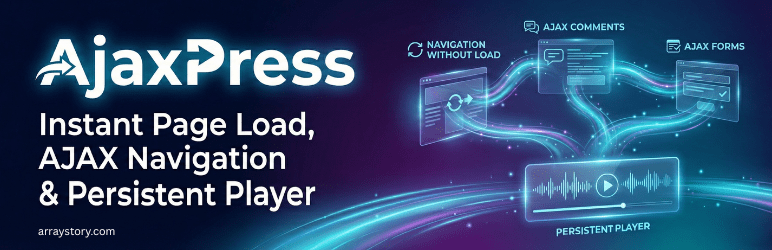
AjaxPress is a WordPress plugin that brings AJAX navigation to any WordPress site. The entire solution adds just 14KB to your frontend.
To put that in perspective: a single small image on your site is probably larger than AjaxPress. A typical WordPress site loads 500KB or more of JavaScript. AjaxPress delivers a fundamentally better navigation experience while barely registering on the performance scale.
That 14KB footprint wasn’t accidental. It reflects a philosophy that solutions should be lightweight, efficient, and respectful of your visitors’ bandwidth and devices.
How It Works
When AjaxPress is active, clicking an internal link triggers a smarter sequence:
- AjaxPress intercepts the click before the browser reloads
- An AJAX request fetches the target page in the background
- Only the main content area swaps out
- Page title and meta information update appropriately
- The URL changes via History API for proper bookmarking
- Everything else—header, footer, sidebar, players, widgets—stays exactly as it was
The entire process completes in milliseconds. Your visitors experience what feels like instant teleportation between pages.
Works Everywhere WordPress Works
AjaxPress operates at the browser navigation level, which means it’s compatible with essentially everything in the WordPress ecosystem.
Any Theme Traditional PHP themes, modern block themes, starter themes, premium themes—all work. AjaxPress doesn’t care how your theme is built.
Any Page Builder Elementor, Gutenberg, Blocksy, Beaver Builder, Divi, Oxygen, Bricks—whatever you use to build pages, AjaxPress handles navigation between them.
Any JavaScript Framework React, Vue, SolidJS, Alpine.js, Petite Vue, jQuery plugins—AjaxPress preserves framework states and doesn’t interfere with their routing.
Any Browser Chrome, Firefox, Safari, Brave, Edge, Opera—every modern browser on every operating system. Windows, macOS, Linux, iOS, Android. Desktop, laptop, tablet, phone.
AjaxPress uses standard web APIs that work universally. If your visitors can browse the web, they can experience AjaxPress-enhanced navigation.
Better Together: Cache + AjaxPress
Remember how caching and AJAX navigation solve different problems? That means they complement each other perfectly.
Caching ensures your content reaches the browser as fast as possible. AjaxPress ensures that content appears without a full page reload.
Together, they compound the performance gains. Cached content arrives quickly, then AjaxPress swaps it in instantly. The combination is noticeably faster than either approach alone.
If you’re already using WP Rocket, LiteSpeed Cache, W3 Total Cache, or Cloudflare—keep using them. AjaxPress works alongside them, making your already-fast site feel even faster.
Browser Controls Work Naturally
AjaxPress enhances navigation without breaking expected browser behavior:
- Back button works correctly
- Forward button works correctly
- Ctrl+R / Cmd+R triggers proper reload
- Bookmarking captures the right URL
- Sharing links works as expected
- Opening links in new tabs bypasses AJAX (as it should)
- Keyboard shortcuts function normally
Your visitors don’t need to learn anything new. The site just works better.
The Transformation
Here’s what changes after AjaxPress is active:
Before: Every click triggers a full page reload. Screen flashes white. Everything rebuilds. Media stops. Widgets reset. The experience feels heavy and disconnected.
After: Clicks swap content smoothly. The interface stays stable. Music keeps playing. Chat stays open. Reading position maintains. The experience feels instant and unified.
The technical difference is how navigation works. The experiential difference is how your site feels to use.
Who Benefits From AjaxPress
E-commerce Sites Product browsing becomes effortless. Customers compare items without waiting through reloads. Shopping feels modern and responsive.
Radio Stations and Music Sites Streams and playlists play continuously while visitors explore. No more interrupted listening, no more frustrated audiences.
Podcast Platforms Episodes keep playing as listeners browse show notes, archives, and recommendations. The listening experience stays intact.
Ebook and Comic Sites Readers navigate chapters smoothly without losing their place or breaking immersion. Reading online finally feels right.
Blogs and Content Sites Article-to-article navigation becomes instant. Readers explore more content, stay longer, engage deeper.
Documentation Sites Technical docs require constant page-hopping. Instant navigation makes research painless and efficient.
Sites With Chat Widgets Support conversations persist across page navigation. Visitors don’t lose their questions mid-thought.
Membership and Course Sites Members browse content libraries fluidly. Learning platforms feel polished and professional.
Any Site Where Experience Matters If you care about how your WordPress site feels to visitors, AjaxPress delivers a noticeable improvement.
Getting Started
AjaxPress works immediately after activation:
- Install AjaxPress from the WordPress plugin directory
- Activate the plugin
- Browse your site—pages now load via AJAX
No configuration required for basic functionality. Settings exist for customization—excluding specific pages, adding transition effects, configuring loading indicators—but most sites work beautifully with defaults.
14KB. Instant activation. Immediate improvement.
The Bottom Line
Full page reloads are legacy browser behavior that modern web applications abandoned years ago. Every traditional WordPress site still suffers from it: the white flash, the pause, the reset of everything interactive.
Caching plugins can’t fix this. They solve a different problem—server response time—while the reload issue is browser behavior.
AjaxPress brings WordPress into the modern era. Your site keeps its header, footer, players, and widgets intact while only updating what actually changes. Navigation becomes instant. Media stays uninterrupted. Interactive elements persist.
All in a 14KB package that works with every theme, every page builder, every browser, every device.
This is what WordPress navigation should feel like. This is AjaxPress.
Install AjaxPress: WordPress Plugin Directory
Documentation & Support: Support Forum